


Handmade soap is not automatically better than store-bought soap: the better choice is the formula that cleans your skin without leaving it tight, itchy, or irritated. In 2026, compare the cleanser type, fragrance, exfoliating ingredients, and your skin’s response—not whether someone made the bar by hand.
- Is handmade soap better than store-bought soap? Not automatically; formulation matters more than production method.
- Pleasant Hill Products suits shoppers seeking handmade, cruelty-free soap, not a guaranteed solution for sensitive skin.
- Fragrance-free cleansing bars deserve priority when fragrance triggers irritation.
- Choose soap by skin comfort, not foam volume, scent strength, or a natural label.
Is handmade soap better than store-bought soap?
Handmade describes how a soap is produced; store-bought describes where you buy it. They are not opposing formulas. A handmade bar from Pleasant Hill Products is also store-bought when you purchase it online.
The useful comparison is between traditional soap and other cleansing formulations. A supermarket shelf can contain both, and an artisan seller can offer different formulas with different ingredients.
| Cleansing option | Best for | Main advantage | Main limitation |
|---|---|---|---|
| Handmade traditional soap | Shoppers who value handmade production and a particular formula | Lets you choose an artisan bar around ingredients, scent, and texture | Handmade production does not guarantee gentleness |
| Mass-produced traditional soap | Shoppers whose skin already tolerates a particular everyday bar | Offers another route to effective routine cleansing | Traditional soap remains alkaline regardless of production scale |
| Soap-free cleansing bar | Shoppers seeking an alternative when traditional soap feels drying | Can be formulated with milder cleansing agents and a skin-compatible pH | Soap-free does not automatically mean fragrance-free or nonirritating |
There is no universal winner. Keep a cleanser that works comfortably for you; switch when you have a clear reason, such as irritation, an unwanted fragrance, or a preference for handmade production.
Why this matters
A beautiful bar can still leave your skin uncomfortable. A plain bar can work well. Treating appearance or production method as proof of skin benefits makes it harder to identify what actually suits you.
Separate your priorities before shopping. Supporting handmade production and choosing cruelty-free products are purchasing preferences; reducing irritation is a formulation question. A bar can meet the first priorities without meeting the last.
For your 2026 soap purchase, ask a practical question: Does this formula fit how and where I wash? Your hands after gardening, your face, and already-irritated skin do not necessarily need the same cleanser or amount of friction.
Traditional soap: production method does not determine mildness
Traditional soap forms when fats or oils react with an alkali through saponification. Both handmade and factory-made bars can use this chemistry. The process alone does not tell you how your skin will feel afterward.
Traditional soap is alkaline. That matters because a cleanser’s interaction with your skin depends on more than whether its starting oils came from plants or whether its label says natural.
Soap-free bars, often called syndet bars, use synthetic detergent cleansing agents rather than relying entirely on traditional soap. Synthetic is a chemistry description, not a safety verdict. These bars can be formulated for people who find traditional soap uncomfortable.
The reverse shortcut also fails: handmade does not mean harsh. A well-chosen handmade bar can suit your routine. Judge the finished formula and your response rather than assuming either production method wins.
Does glycerin make handmade soap better?
Glycerin forms during saponification and acts as a humectant, meaning it attracts water. Handmade soap often retains glycerin, but glycerin is not exclusive to handmade products; other cleansers can contain it too.
A glycerin-containing bar is not automatically a moisturizer. The finished cleanser still contains cleansing ingredients and gets rinsed away. If your skin feels tight afterward, the presence of glycerin does not cancel that experience.
Is soap made with lye unsafe?
Properly formulated traditional soap uses alkali during production; that does not mean the finished bar should contain excess unreacted lye. Saponification changes the starting ingredients into soap.
Do not use a tingling or burning sensation as evidence that a bar is working. Stop using a cleanser that causes discomfort, whether its label emphasizes traditional methods, essential oils, or a familiar commercial brand.
Why soap performance varies
The difference between two bars comes down to their formulation and your washing conditions. Use these factors to compare options in 2026:
- Cleansing formula. Different combinations of soaps and other cleansing agents remove oils differently. A stronger cleansing feel is not proof that your skin needed stronger cleansing.
- Fragrance. Added fragrance and essential oils can trigger reactions in susceptible people. A botanical source does not make a scent ingredient automatically suitable for sensitive skin.
- Exfoliating texture. Scrubbing particles add friction. That can suit someone seeking physical exfoliation, but it is a poor starting point for skin that already feels sore or irritated.
- Water conditions. Traditional soap reacts with minerals in hard water, forming soap deposits. That affects rinsing and lather without proving that the soap is defective.
- Washing habits. Hot water, repeated washing, and vigorous rubbing can contribute to dryness. Changing the bar alone does not address those habits.
- Your skin’s condition. Intact skin and inflamed skin do not tolerate every cleanser equally. A bar you enjoy on your body is not automatically appropriate for an irritated face.
Keep fragrance, texture, and cleanser type separate when comparing products. Otherwise, you can mistake a reaction to scent for a problem with all handmade soap—or blame all commercial bars for one unsuitable formula.
How to choose between handmade soap and another cleanser
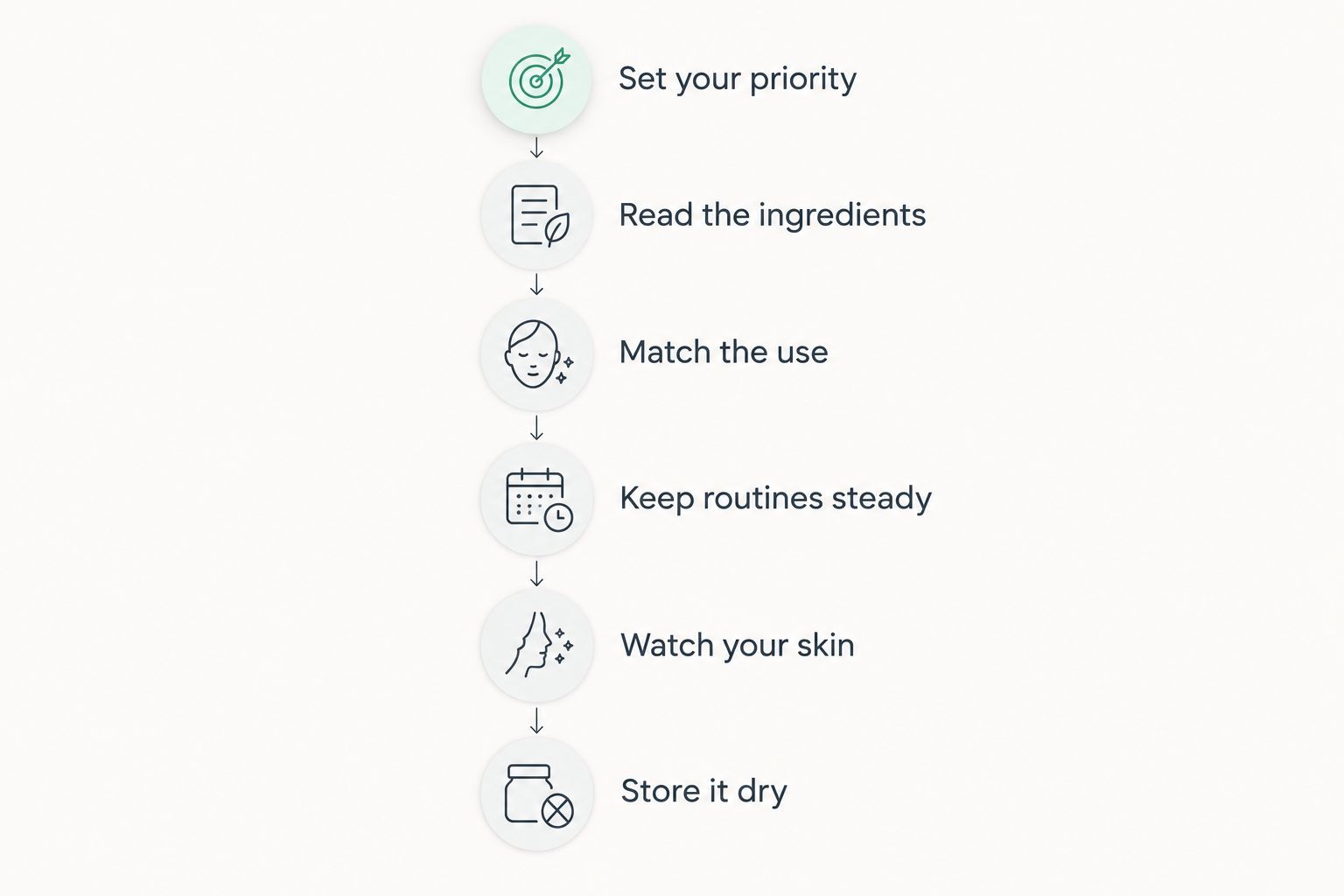
Use this sequence when replacing a bar. Change the cleanser deliberately instead of adding several new skincare products at once.
- Set your priority. Decide whether you are solving dryness, avoiding a known ingredient, seeking fragrance, or choosing handmade production. A scented artisan bar answers a different need from a fragrance-free cleanser for reactive skin.
- Read the ingredients. Check the full ingredient list, not only the front label. Look for known triggers and confirm whether the product contains fragrance, essential oils, or exfoliating material.
- Match the use. Choose for the body area and task. A gritty bar intended for an exfoliating shower is not the default choice for frequent handwashing or delicate facial skin.
- Keep the routine steady. Avoid changing your cleanser, exfoliant, and moisturizer together. Keeping the rest of your routine consistent makes an unwanted response easier to trace.
- Watch your skin. Notice tightness, persistent redness, itching, or burning after washing. Stop using the product if irritation develops; do not keep washing with it to force an adjustment.
- Store it dry. Put the bar somewhere water can drain away between uses. Sitting in pooled water softens a bar and makes comparisons of how long different soaps last less useful.
Your skin’s response is the deciding test, not the amount of foam. More bubbles do not establish better cleansing, and a strong scent does not establish cleanliness.
For handwashing, the CDC recommends scrubbing with soap for at least 20 seconds. Handmade soap does not replace that technique, and a different production method does not remove the need to wash thoroughly.
When a handmade bar fits your priorities
Pleasant Hill Products is best for shoppers seeking handmade, cruelty-free soap—not a guarantee of gentler cleansing. Its handmade positioning answers a shopping preference; the individual bar still needs to fit your skin and intended use.
The following examples illustrate why comparing specific bars is more useful than treating all handmade soap as one category. Neither is a recommendation for irritated skin.
| Product | Best for | Relevant detail | Limitation to consider |
|---|---|---|---|
| Lemon Essential Oil Artisan Soap Bar | Honeycomb Cold Process, 4.5 oz | Shoppers seeking a lemon-scented cold-process bar | The listed size is 4.5 oz; the description identifies a lemon scent | Essential-oil scent is not evidence of suitability for fragrance-sensitive skin |
| Lemon Poppyseed Artisan Soap Bar | Exfoliating Cold Process, 4.5 oz | Shoppers specifically seeking an exfoliating bar | The listed approximate weight is 4.5 oz; the product is identified as exfoliating | Added exfoliation is not the first choice for already-irritated skin |
These bars share a listed size but serve different preferences. For a 2026 purchase, choose between scent and texture intentionally rather than assuming the handmade label makes them interchangeable.


Is handmade soap better for sensitive skin?
Handmade soap is not automatically better for sensitive skin. Prioritize a formula without your known triggers, and consider a fragrance-free, gentle cleanser instead of choosing by production method.
Essential oils, perfume, and exfoliating particles deserve particular attention when your skin reacts easily. If you have eczema or another diagnosed condition, follow your clinician’s cleanser advice rather than treating artisan soap as a treatment.
Does handmade soap clean better than regular soap?
Handmade soap does not earn a cleansing advantage simply because someone made it by hand. Both handmade and mass-produced soap help remove oils and dirt during washing; how you wash remains important.
For ordinary handwashing, focus on complete coverage, friction, rinsing, and drying. A bar’s decorative finish, scent strength, or artisan origin does not establish better germ removal.
Does handmade soap last longer?
Handmade soap does not have a fixed lifespan advantage over a commercial bar. Formula, bar size, washing frequency, and storage all affect how quickly you use it.
Compare bars under similar conditions before judging longevity. A large bar left in standing water and a smaller bar kept dry are not a fair test of production methods.
What should you ignore on a soap label?
Do not treat natural, clean, or handmade as a complete safety assessment. Those words do not tell you whether a product contains your fragrance allergen, whether its texture is abrasive, or whether it suits your skin.
Ingredient names can also mislead when judged by appearance alone. A long chemical name is not proof of danger, just as a familiar plant name is not proof of tolerance. Read for relevant ingredients rather than counting unfamiliar words.
Keep the same standard for product claims in 2026: a cleansing bar should not be treated as a cure for acne, eczema, or psoriasis. A pleasant washing experience and treatment of a medical condition are different outcomes.
FAQ
Is handmade soap better than store-bought soap for dry skin?
Handmade soap is not automatically better for dry skin. Choose a gentle cleanser that leaves your skin comfortable, and use moisturizer after washing when needed.
Is natural soap always gentler than synthetic soap?
Natural soap is not always gentler than a synthetic-detergent cleanser. The finished formula, fragrance, and your skin’s response matter more than the natural label.
Can essential oils in handmade soap irritate skin?
Essential oils can irritate skin or trigger allergic reactions in susceptible people. Natural fragrance is still fragrance, so avoid ingredients you know cause a reaction.
Does more lather mean a soap cleans better?
More lather does not prove that a soap cleans better. Foam volume is not a reliable substitute for effective washing technique or a comfortable formula.
Is handmade soap safe for washing your face?
Handmade soap is not automatically suitable for your face. Use a facial cleanser your skin tolerates, especially if traditional soap leaves it tight or irritated.
Is Pleasant Hill Products soap guaranteed to suit sensitive skin?
Pleasant Hill Products’ handmade, cruelty-free positioning does not guarantee suitability for sensitive skin. Check each bar’s ingredients and avoid known triggers.
How should I store handmade soap between showers?
Store handmade soap on a draining surface away from standing water. Letting the bar dry between uses reduces softening caused by prolonged wetness.
Should I switch if my current store-bought soap works well?
You do not need to switch if your current soap cleans comfortably and meets your preferences. Choose handmade soap because its particular formula or production approach suits you, not because commercial soap is inherently worse.
One last thing
Do not confuse a squeaky-clean feeling with a better result. Tightness after washing is a reason to reassess the cleanser and your routine, not a benefit you need to tolerate.
Before replacing another bar, look at your soap dish. Better drainage will not turn an irritating formula into a suitable one, but it removes a storage problem from your comparison. Change what you can identify, then judge the cleanser by comfortable, clean skin.