


Best overall for routine baby cleansing: a fragrance-free cleanser labeled for infant use. Best goat milk soap for babies: a smooth, fragrance-free bar whose complete formula your pediatrician considers suitable. This 2026 guide separates those choices from scented and exfoliating bars that do not belong in an infant’s routine.
- Choose goat milk soap for babies by the complete formula, not the milk ingredient alone.
- A fragrance-free infant cleanser is the default choice; goat milk bars need a separate suitability check.
- Pleasant Hill Products’ Sweet Dreams contains essential oils; it is not the fragrance-free choice in this guide.
- Skip salt scrubs on infant skin, and ask your pediatrician about eczema or a known milk allergy.
Why this matters
Goat milk is an ingredient, not an infant-safety certification. A goat milk bar can still contain fragrance, essential oils, exfoliating particles, or a soap base that leaves your baby’s skin feeling dry. Choose the finished cleanser, not the ingredient story.
Pleasant Hill Products sells natural, handmade, cruelty-free soap and small-batch skincare. Those qualities describe the store’s products; they do not establish that a particular bar suits a newborn, treats eczema, or is safe around the eyes.
For your 2026 shopping decision, keep two questions separate: does the product contain goat milk, and is the complete product appropriate for your baby? Neither answer supplies the other. A pleasant scent or creamy lather cannot replace an infant-use label and a readable ingredient list.
What makes the best goat milk soap for babies?
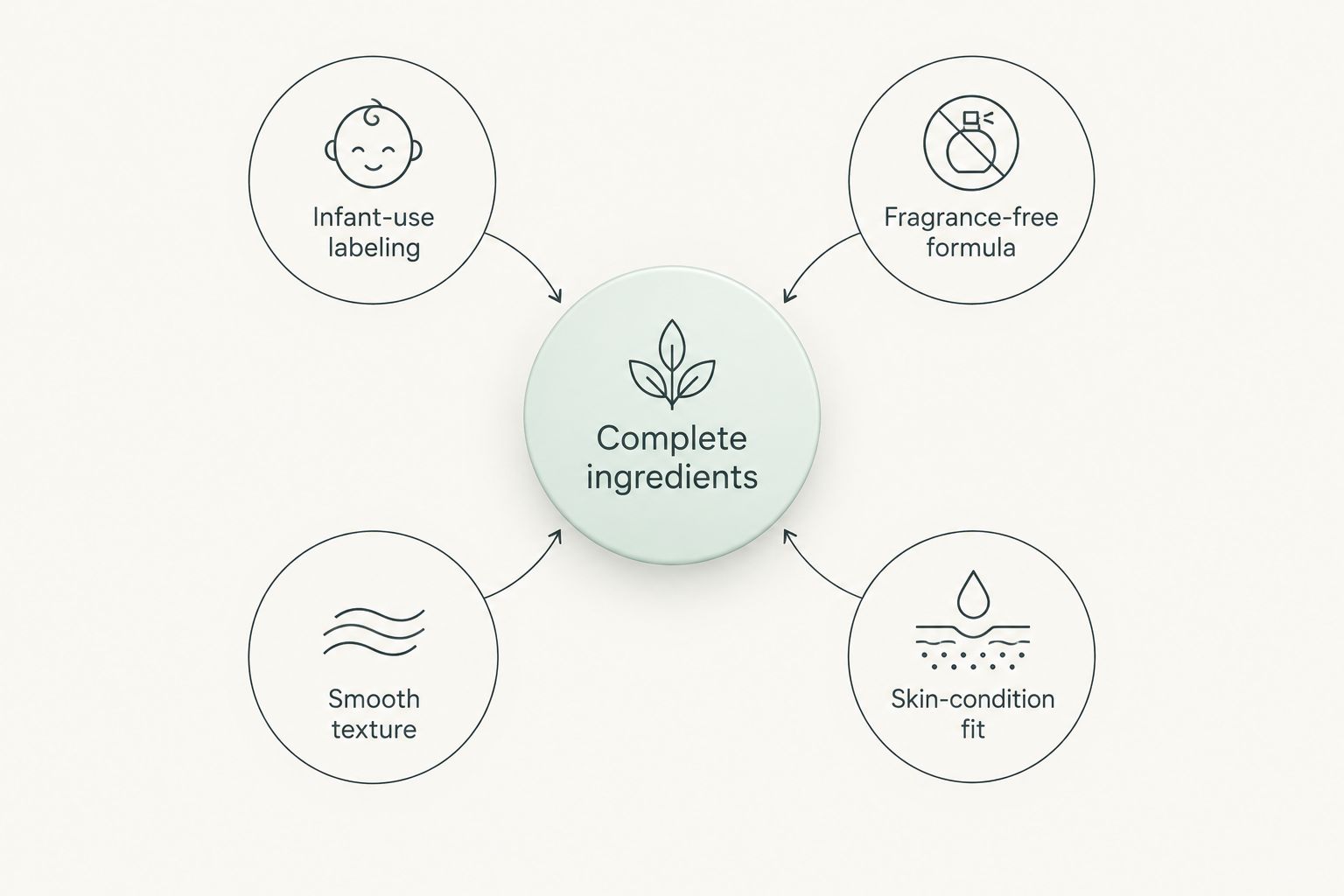
Use these criteria before comparing bars. They matter more than packaging, color, or a claim that a soap is natural.
- Infant-use labeling: Look for directions that specifically address babies. A general-purpose family soap needs a separate suitability check.
- Fragrance-free formula: Avoid added perfume and essential oils when choosing a low-irritant baby routine. Unscented and fragrance-free are not interchangeable claims.
- Smooth texture: Exclude scrub particles and decorative botanicals that contact the skin. Infant cleansing does not need an exfoliation step.
- Complete ingredients: Read the entire list, including the cleansing base, fragrance ingredients, and milk ingredients. A featured ingredient is only part of the formula.
- Skin-condition fit: Ask your pediatrician about persistent dryness, eczema, broken skin, or a known milk allergy before introducing a goat milk bar.
- Clear use instructions: Check where the cleanser can be used and how to rinse it. Never infer tear-free performance from a gentle-sounding name.
A shorter ingredient list is easier to review, but length alone does not prove mildness. Likewise, handmade describes production; it does not tell you how a cleanser behaves on infant skin.
Baby cleansing options at a glance
This 2026 comparison ranks choices by their role in a baby routine, not by scent or gift appeal. The named artisan bars illustrate why a product can be attractive for a household purchase yet fail the criteria for an infant cleanser.
| Rank and option | Best for | Standout feature | Key limitation | Verdict |
|---|---|---|---|---|
| 1. Fragrance-free infant cleanser | A default routine-cleansing choice | Explicit infant-use directions | Fragrance-free alone does not guarantee tolerance | Buy after checking the label |
| 2. Smooth, fragrance-free goat milk bar | Parents specifically seeking a milk-based bar | Goat milk without added scent or scrub texture | The complete formula still needs review | Hold until suitability is established |
| 3. Sweet Dreams Lavender Soap Bar | Shoppers seeking a scented handmade soap, not an infant default | Lavender positioning and an essential-oil blend | Does not meet the fragrance-free criterion | Skip for the baby routine |
| 4. Gulf Shores Himalayan Salt Scrub Soap with Yellow Clay | Shoppers seeking an exfoliating scrub, not infant cleansing | Himalayan salt for exfoliation | Scrub action is unnecessary for infant care | Skip for the baby routine |
1. Fragrance-free infant cleanser: best for routine baby washing
A fragrance-free cleanser labeled for infants is the practical starting point when your goal is cleaning your baby rather than buying a particular ingredient. Choose a gentle formula with clear directions, and use it only where cleansing is needed. A non-soap cleanser, sometimes called a syndet, is a different category from a traditional soap bar.
The American Academy of Dermatology recommends mild, fragrance-free cleansing products in eczema care. That guidance supports a formula-first approach; it does not mean every fragrance-free product is suitable for every infant.
Fragrance-free infant cleanser pros:
- Infant-use directions give you a clearer starting point than general skincare claims.
- Avoiding added fragrance removes an unnecessary ingredient from the routine.
- Liquid and bar formats let you choose handling that suits your bath setup.
Fragrance-free infant cleanser cons:
- Fragrance-free does not mean allergy-proof or irritation-proof.
- A baby label does not establish that a cleanser treats eczema.
- Directions and ingredients still need checking before use.
Best for: Parents who want a straightforward routine cleanser without making goat milk a requirement.
Verdict: Buy after checking infant-use directions and the complete ingredient list. For an undecided parent in 2026, this is the default category—not a scented artisan bar repurposed for the bath.
2. Smooth, fragrance-free goat milk bar: best for a milk-based preference
A smooth, fragrance-free goat milk bar is the closest match to the search for goat milk soap for babies. Goat milk identifies one ingredient; the oils, cleansing base, additives, and finished formula determine the rest of the product. Traditional soap is generally alkaline, so a milk ingredient does not turn it into a pH-neutral cleanser.
Choose this category only after checking infant-use guidance and discussing relevant skin concerns with your pediatrician. Goat milk soap is not an eczema treatment or an automatic upgrade over a gentle infant cleanser.
Smooth, fragrance-free goat milk bar pros:
- It matches a specific preference for a milk-containing bar.
- A genuinely fragrance-free formula avoids added perfume.
- A smooth bar avoids the scrub texture found in exfoliating soaps.
Smooth, fragrance-free goat milk bar cons:
- Goat milk alone does not establish mildness or infant suitability.
- Traditional soap can leave sensitive skin feeling dry.
- A known milk allergy requires medical advice before use.
Best for: Parents specifically seeking goat milk who have confirmed that the finished product fits their baby’s needs.
Verdict: Hold until the complete formula and infant suitability are established. Do not buy on the strength of the words natural, nourishing, or handmade.
3. Sweet Dreams Lavender Soap Bar: best for scented-soap shopping
Pleasant Hill Products’ Sweet Dreams Lavender Soap Bar is described as a handcrafted soap with a blend of pure essential oils. That makes it a scented-soap option, not the fragrance-free choice recommended for a simple infant routine. Its lavender name does not establish a sleep benefit for babies.
Keep adult scent preferences separate from infant cleansing decisions. A bath product does not need to smell relaxing to clean skin.
Sweet Dreams Lavender Soap Bar pros:
- Its lavender positioning clearly identifies the scent-oriented use case.
- The description explicitly identifies an essential-oil blend.
- Its handcrafted bar format suits shoppers looking for artisan soap.
Sweet Dreams Lavender Soap Bar cons:
- Essential oils do not meet this guide’s fragrance-free criterion.
- The product name does not establish tear-free performance.
- Lavender positioning does not establish infant suitability or better sleep.
Best for: Shoppers seeking scented handmade soap for a separate household routine—not parents selecting a default baby cleanser.
Verdict: Skip for the baby routine. Choose an infant-appropriate fragrance-free cleanser instead of treating a bedtime-themed name as evidence.
4. Gulf Shores salt scrub: best for exfoliating-soap shopping
Pleasant Hill Products’ Gulf Shores Himalayan Salt Scrub Soap with Yellow Clay contains Himalayan salt for exfoliation, according to its product description. That function distinguishes it from a smooth cleansing bar. It also makes the scrub a poor match for an infant routine.
Your baby does not need salt particles or scrub action to remove everyday dirt. Keep exfoliating products separate from the products you select for infant washing.
Gulf Shores salt scrub pros:
- The description clearly identifies the exfoliating function.
- Himalayan salt and yellow clay are named ingredients in the product description.
- The handmade bar format serves a distinct scrub-shopping use case.
Gulf Shores salt scrub cons:
- Exfoliation adds an unnecessary step to infant cleansing.
- Scrubbing can irritate delicate or already inflamed skin.
- A salt-and-clay description does not establish infant suitability.
Best for: Shoppers seeking an exfoliating soap outside the baby’s cleansing routine.
Verdict: Skip for babies. A smooth texture is a basic selection criterion, not an optional preference.
How the choices are ranked
The ranking puts infant-use directions, fragrance avoidance, smooth texture, and skin-condition fit ahead of artisan appeal. It distinguishes a routine cleanser from a conditional goat milk choice and from products whose stated functions conflict with those criteria.
These are selection judgments, not clinical trial results. No named bar earns an infant recommendation from its scent, handmade production, or featured ingredient. For 2026, the decision rule is simple: establish suitability before comparing appeal.
How to use a cleanser without overdoing the bath
The American Academy of Pediatrics advises that about 3 baths per week during the first 12 months can be enough, provided you clean the diaper area thoroughly. That is general infant-care guidance, not a reason to ignore dirt or your pediatrician’s instructions. More washing is not automatically better skincare.
For eczema care, the American Academy of Dermatology recommends short baths of 5–10 minutes in warm—not hot—water. Follow your child’s clinician’s plan if eczema is present; do not substitute a goat milk bar for treatment.
Use this sequence when introducing a suitable cleanser:
- Read the label. Confirm the intended age group, ingredients, and directions before the bath starts.
- Use gentle contact. Make lather in your hands rather than rubbing a bar directly over the baby’s skin.
- Clean where needed. Avoid eyes and unnecessary scrubbing; a cleanser is not required on every area at every wash.
- Rinse completely. Remove cleanser residue, then pat the skin dry rather than rubbing.
- Watch the response. Stop using the product if redness, discomfort, or a rash develops, and seek medical advice when symptoms persist.
Introduce 1 new product at a time so you do not change the cleanser and several other skincare products together. This is a practical tracking step, not an allergy test. A small trial at home cannot rule out an allergic reaction.
Which baby cleanser should you choose?
Choose a fragrance-free infant cleanser unless you have a specific, reviewed reason to choose goat milk soap. If you want a milk-based bar, require a smooth texture, a complete ingredient list, and suitable use guidance before adding it to the bath routine.
Pleasant Hill Products’ handmade soap category suits shoppers seeking artisan soaps; infant suitability remains a product-level decision. Keep scented and exfoliating purchases separate from your baby’s cleanser. Your 2026 choice should follow the label and your child’s skin needs, not a family preference for one brand or ingredient.
FAQ
What’s the best goat milk soap for babies?
The best candidate is a smooth, fragrance-free goat milk bar with a complete ingredient list and confirmed suitability for your baby. Goat milk alone does not establish safety or mildness. A fragrance-free infant cleanser is the default alternative.
Is goat milk soap safe for newborns?
Goat milk soap is not automatically suitable for newborns. Check the finished product’s infant-use directions and ask your pediatrician before using a general-purpose bar, especially when skin concerns are present.
Is goat milk soap better than baby wash?
Goat milk soap is not inherently better than a gentle, fragrance-free baby wash. Compare the complete formulas and intended use rather than treating the milk ingredient as proof of better performance.
Can goat milk soap treat my baby’s eczema?
Goat milk soap is not an eczema treatment. Follow your pediatrician’s care plan and choose cleansing products that fit that plan rather than replacing treatment with a milk-based bar.
Can I use lavender soap for my baby’s bedtime bath?
A lavender scent does not establish infant suitability or a sleep benefit. Essential-oil soap does not meet this guide’s fragrance-free criterion; choose a suitable fragrance-free infant cleanser instead.
Can a baby with a milk allergy use goat milk soap?
Ask your baby’s clinician before using goat milk soap when a milk allergy is known or suspected. Do not assume that a rinse-off product is safe or use a home trial to rule out an allergy.
How often should I bathe my baby?
The American Academy of Pediatrics advises that about three baths per week during the first year can be enough if the diaper area is cleaned thoroughly. Adjust care for actual soiling and follow your pediatrician’s instructions.
Does handmade goat milk soap mean it is tear-free?
Handmade goat milk soap does not establish tear-free performance. Follow the product’s directions and keep cleanser away from your baby’s eyes unless its labeling specifically supports that use.
One last thing
Unscented is not the same as fragrance-free. An unscented product can contain ingredients used to mask odor, so do not stop reading at the front label. For your 2026 purchase, check both the fragrance claim and the full ingredient list before deciding that a bar belongs in your baby’s bath.